How to Track Open Dates Without Overcomplicating Your Pantry
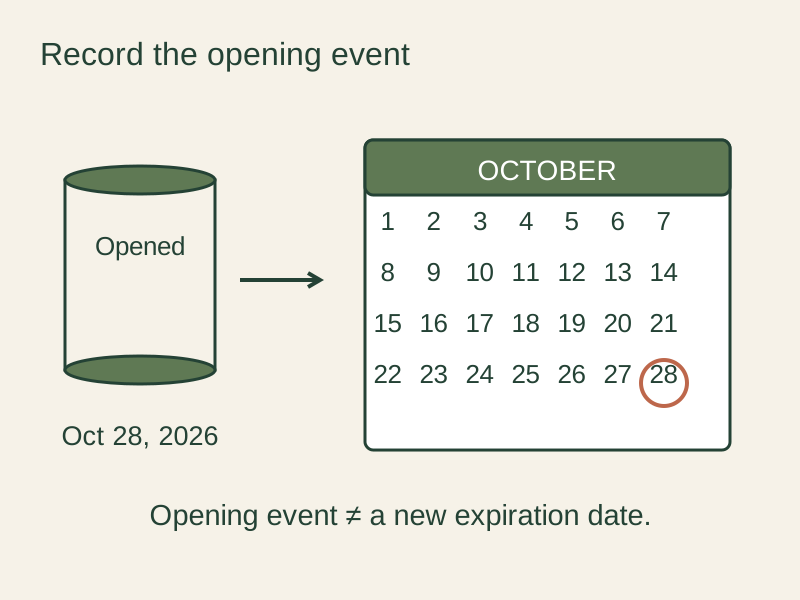
An opening date is a record of an event. It tells you when you broke the seal, which can help you apply the food's actual handling directions later.
In this guide
- Write down what happened, not a guessed deadline
- Pick the foods where a date helps
- Put the date where your hand already goes
- Distinguish the dates you already have
- Build one small opening routine
- Use the directions when you make a plan
- Handle a missing date honestly
- Keep a short list only when it helps
- Aim for less uncertainty
Write down what happened, not a guessed deadline
An opening date is a record of an event. It tells you when you broke the seal, which can help you apply the food's actual handling directions later.
It does not create a new storage period or prove a food is safe. Start with the package's after-opening instructions, then add a simple date that helps you follow them.
Use a complete, unambiguous date such as “opened October 28, 2026.” If you use numbers, write the year and a consistent order so another person does not have to guess what the label means.
The EPA's home food-waste guidance recommends labeling stored food with contents and dates. The small system below is an editorial way to make that habit practical in a busy pantry.
Pick the foods where a date helps
Start with packages that carry meaningful after-opening instructions or that your household repeatedly forgets. A broth carton, a jar of peanut butter, and a baking ingredient can raise different questions once opened.
Read the exact package rather than assigning every food the same countdown. A direction about refrigeration is different from a quality recommendation and should remain readable alongside the date.
If a product offers no clear after-opening direction, do not borrow one from a similar-looking food. Check the maker's exact product information or a relevant official storage resource.
You do not need to date every item in the kitchen on the first day. Choose a few foods where the missing information has actually caused confusion and build a reliable habit there.
A useful label helps you make a decision. If an extra date adds clutter without answering a real question, a clearer food identity or an easier-to-find original label may be the better improvement.

Put the date where your hand already goes
Place the label near the lid, cap, or front surface you see when you put the food away. A note hidden on the bottom is easy to overlook until you have already started cooking.
Keep it outside the food and avoid covering the original lot code, date wording, ingredients, or directions. You want the new note to work with the package, not replace its useful information.
For a carton you store upright, a small note near the cap can be easier to read than a note on a folded side. For a jar, check that the mark remains visible when several jars share a shelf.
Choose a marking method suitable for that surface and storage environment. A label that falls off or ink that wipes away leaves you with the same uncertainty you were trying to solve.
If you transfer food to another container, move its identity and handling instructions with it. A date by itself is not enough to identify an unlabeled leftover.
Distinguish the dates you already have
Keep the original printed date phrase beside its date. “Best if used by” and “opened” describe different things, and your handwriting should not blur them together.
A transfer date is different again. If you opened a package Monday and moved the food to a container Tuesday, marking only Tuesday would lose a day of its actual history.
A cooked date applies to the prepared food. It is not automatically the same as the opening date of one ingredient you used in the recipe.
A personal reminder can be useful, but identify it clearly as a reminder. Writing “check Thursday” is more honest than presenting Thursday as an official expiration date you calculated without product guidance.
If a label has room for only two lines, use the exact food name and the event date. Keep the complete directions and original printed date elsewhere in a clearly connected record.
Illustration: swipe left or right, or focus the diagram and use the arrow keys, to see every label.
Build one small opening routine
When you open the package, read the relevant direction before you pour or serve. Add the opening date while the package is still on the counter.
Put it in the correct storage location immediately after you finish using it. A perfect date label does not make up for handling that conflicts with the product's directions.
Return the pen or labels to the same place each time. If marking a date requires searching three drawers, it will become the step everyone skips.
You can keep a small label pad near your pantry or refrigerator, provided it stays separate from food-contact surfaces. The routine should take seconds and work without a special app or subscription.
For shared groceries, agree that the person who opens the package marks it. That avoids the common situation where everyone assumes someone else will remember.
Use the directions when you make a plan
At meal-planning time, look at the foods you already opened before buying another package. Read their instructions and decide which planned dishes can use them appropriately.
If you have an opened broth carton, write down an actual next use rather than simply moving it to the front. A recipe and a cooking day make the reminder more actionable.
For a product with a stated after-opening period, keep that exact wording available. If you calculate a reminder from it, check the calendar carefully and do not treat the calculated date as a substitute for proper storage.
Avoid adding a fresh opening label when you move the food or use it again. The first opening date remains the relevant event unless the manufacturer specifies another basis.
For prepared leftovers, use guidance that matches the finished food rather than the longest-lived ingredient. The FoodSafety.gov cold-storage chart provides category-specific guidance and lists refrigerator storage at 40°F or below.
Handle a missing date honestly
If you cannot remember when a package was opened, write “opening date unknown” rather than choosing a reassuring number. Check the food's specific directions and relevant safety guidance before deciding what to do.
A receipt may tell you when you bought the food, but purchase and opening are different events. A photograph can establish that a package was already open at a certain time without proving exactly when you first opened it.
Do not use smell or a tidy label as a universal safety test. If the history you need is missing, a freshly written date cannot restore it.
For a recalled product, follow the recall instructions regardless of your date note. The FoodSafety.gov recall page directs you to match the detailed product information and avoid consuming a matching recalled item.
After an uncertain package is resolved, improve the routine at the moment of opening. You do not need a more complicated tracking system if the real problem was that the pen lived in another room.
Keep a short list only when it helps
A separate open-food list can be useful for a crowded refrigerator or several household cooks. Limit it to product name, opening date, storage location, and a pointer to the directions.
Cross the item off when it is gone. An outdated list makes it harder to see what actually needs attention and can send you shopping for food you already finished.
If the container labels work well on their own, skip the duplicate list. Maintaining two records is worthwhile only when the second one makes planning easier.
For a household with changing schedules, review the list before the next grocery order. An ingredient that had a clear use on Sunday may need a different plan after several meals away from home.
Aim for less uncertainty
The goal is to know which food you have, when you opened it, and which directions apply. A date label should make those facts easier to find without pretending to answer every food-safety question.
Start with one marker, one consistent date format, and one place for the original instructions. A small routine you use every time is more useful than a detailed system you abandon after the first week.
Sources & product information
Relevant pages checked October 28–29, 2026. Product information is the maker’s or retailer’s description; the practical examples and choices are Shelf Savvy editorial guidance.