How to Keep Package Directions When You Decant Food
A matching row of pantry jars is useful only if you can still identify what is inside. Before you decant a food, decide where its complete directions and original identification will live.
In this guide
- Save the information before you pour
- Decide whether decanting solves a real problem
- Make a two-part label
- Capture the complete package
- Preserve directions as a set
- Keep one product and one batch together
- Separate your notes from the maker's words
- Test the system before filling every jar
- Keep the link until the food is gone
Save the information before you pour
A matching row of pantry jars is useful only if you can still identify what is inside. Before you decant a food, decide where its complete directions and original identification will live.
Keep the package nearby until the new container is labeled and the information is readable. Waiting until after you throw the bag away turns a simple organizing job into a search for a label that may belong to a different product.
You need more than the ingredient's everyday name. The exact variety, ingredients, allergen information, preparation method, storage directions, date wording, and identifying codes can all matter later.
The FDA explains that recall notices identify products using details such as name, package size, UPC, product codes, and dates. A jar marked only “oats” loses much of that connection to the original package.
Decide whether decanting solves a real problem
Start with the task you want the container to do. You might need a lid that closes securely, a shape that fits a shelf, or an easier way to measure an ingredient.
If the original package already works well, you can put it inside a larger container instead of pouring the food out. That keeps the label and food together and avoids copying directions by hand.
A container also needs to suit food storage and the particular ingredient. Check its own instructions rather than assuming every attractive jar is appropriate for every pantry food.
Make sure the container is clean and fully dry before use. Do not use a new storage project as a reason to move food that shows damage, contamination, or an unexplained history into a prettier package.
The University of Minnesota's pantry-pest guidance describes tightly closed glass, metal, or heavy plastic containers as a storage option for insect-free dry foods. A new container does not repair food that is already infested.

Make a two-part label
Put the quick-use information where you can see it without lifting the jar. That usually means the exact food name, an opening or transfer date when relevant, and a short pointer to the original directions.
Keep the full package information as a second layer. You can retain a clean label panel in an outside sleeve or keep a clearly matched photograph that everyone using the food can find.
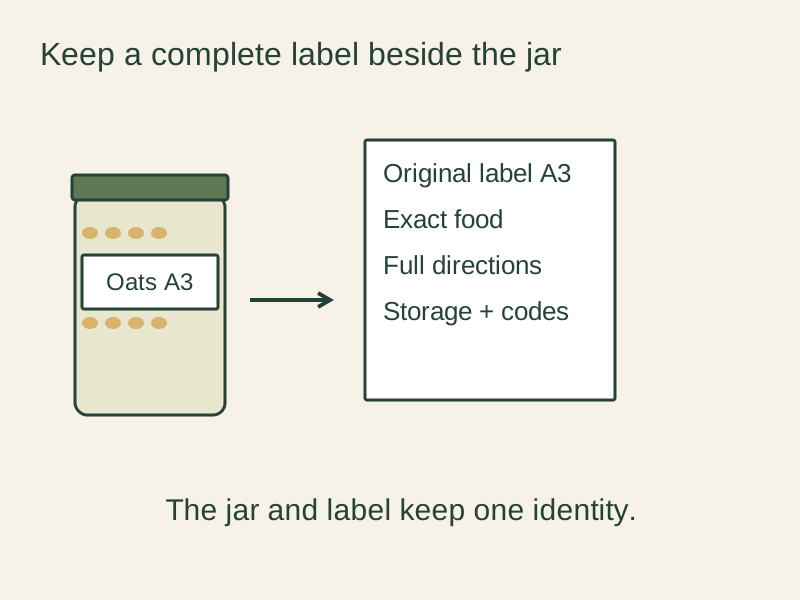
A front label might say “old-fashioned rolled oats, opened October 28, directions in pantry folder A3.” The folder entry should show that specific package, including the back and any codes printed on another surface.
Use a food name that distinguishes similar ingredients. “All-purpose wheat flour” tells a cook more than “flour,” and “self-rising flour” needs its own unmistakable identity.
Avoid copying a long instruction into tiny handwriting that no one can read while cooking. A short, legible pointer plus a complete original record is usually more dependable than a crowded homemade replacement label.
Capture the complete package
Photograph the front, ingredient and allergen panels, preparation directions, storage instructions, and date or lot codes. Check the pictures before discarding anything, since glare and folded seams can hide exactly the line you need.
Include any instructions printed on the lid, bottom, or inner flap. A front-and-back picture is not complete when the relevant handling direction sits on the top seam.
Name the file so it can be connected to the container. A simple identifier such as “oats A3” works better than leaving the photograph buried among unrelated camera-roll pictures.
If you keep a paper panel, attach it outside the food container or store it in a nearby labeled folder. Avoid placing scraps of packaging, tape, or ink-bearing paper loose inside the food.
Do not assume the maker's website is a permanent substitute for your package record. Products and labels can change, and a current page may describe another size, recipe, or version.
Illustration: swipe left or right, or focus the diagram and use the arrow keys, to see every label.
Preserve directions as a set
Preparation instructions work together. The ingredient amount, liquid amount, equipment, order of steps, and timing belong in the same record.
For example, a note that says “cook five minutes” is incomplete if it loses how much food and water that timing assumes. Keep the full preparation panel even when you usually make only one familiar portion.
Some packages offer separate stovetop, microwave, and recipe instructions. Mark the method you normally use, but retain the alternatives instead of blending them into a single improvised set of directions.
For a mix, keep the list of ingredients you must add. Otherwise you may discover at cooking time that the convenient pantry jar still requires milk, eggs, oil, or another ingredient you forgot to buy.
For a food with after-opening storage directions, make those easy to spot on the outside label. Transferring it does not change what the food needs after opening.
Keep one product and one batch together
Resist topping off a partly empty jar with a new package. Mixing batches makes it harder to know which date, lot code, or directions apply to the food you are using.
Finish the older food before transferring the new package, or keep the new one separate. That gives you a clear moment to clean the container and replace its label record.
If one large package fills two containers, give both a matching identifier. Keep the original package record until both containers are empty so the second one does not become anonymous.
If two visually similar foods have different ingredients or handling instructions, give them separate containers and labels. Color can help as an extra cue, but the written identity needs to work without relying on color alone.
For a shared kitchen, show other cooks where the full label lives. An elaborate system that only one person understands is easy to bypass when someone is making a quick breakfast.
Separate your notes from the maker's words
You can add useful household notes such as “use the half-cup scoop” or “fits the blue recipe binder.” Label them as your own notes so they are not mistaken for manufacturer instructions.
Keep the original date phrase with its date. Writing only “November 14” loses whether it was a best-by date, an opening date, or a reminder you chose yourself.
If you change the quantity for a favorite recipe, store that adaptation beside the original method. It helps the next cook see what was printed on the package and what your household adjusted.
Never turn a convenient reminder into a made-up storage period. If you cannot find the relevant direction, keep the original information and seek product-specific guidance before deciding how to store it.
Test the system before filling every jar
Try one ingredient first and use it for a normal cooking session. Check whether you can identify the food, find the directions, and return the container to the shelf without losing its record.
Ask another household member to find the same information. If they need you to explain a private abbreviation, simplify it before repeating the method across the pantry.
You may discover that an outside sleeve is easier than a phone folder, or that leaving the bag inside a bin works best. The useful design is the one that survives ordinary cooking and restocking.
Keep the link until the food is gone
When you finish the food, remove its quick label and archive or discard the matching package record as appropriate. Start fresh for the next product rather than letting an old label silently follow a new ingredient.
Decanting should make food easier to use while keeping its identity intact. If you can still answer what it is, how to prepare it, and which original package it came from, the container is doing its job.
Sources & product information
Relevant pages checked October 28–29, 2026. Product information is the maker’s or retailer’s description; the practical examples and choices are Shelf Savvy editorial guidance.