Serving Size vs. Package Size: Read the Whole Label
The serving size on a label and the amount in a package answer different questions. One gives you the reference amount for reading nutrition information, while the other helps you work out what you are buying and how many meals it can cover.
In this guide
- Start at the top of the Nutrition Facts panel
- Keep four amounts in view
- Compare equal amounts before comparing nutrients
- Notice a second column
- Turn the package into a meal-planning amount
- Include what you add during preparation
- Treat “about” as useful honesty
- Use a different ruler for shopping value
- Build a quick label-reading habit
Start at the top of the Nutrition Facts panel
The serving size on a label and the amount in a package answer different questions. One gives you the reference amount for reading nutrition information, while the other helps you work out what you are buying and how many meals it can cover.
Look for “servings per container” and “serving size” before comparing any nutrient numbers. Then read the net quantity on the package so you do not mistake a serving for everything inside.
The FDA's serving-size explanation says serving sizes reflect amounts people typically consume, rather than an instruction about how much you should eat. They appear as a household measure followed by a metric amount.
That means a half-cup label serving is a reference for the panel. Your actual portion might be smaller or larger, depending on your meal and personal needs.
Keep four amounts in view
Package amount is the quantity of food the product contains. Serving size is the amount associated with the nutrition numbers shown in a particular column.
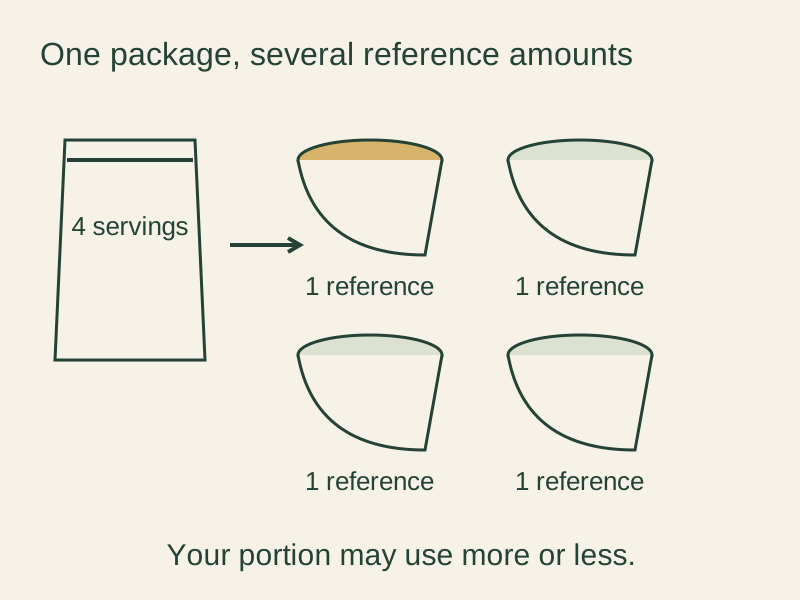
Servings per container tells you how many of those reference amounts the package contains, often with the word “about.” Your portion is the amount you actually put in your bowl or use in a recipe.
You can write those four items on a scratch pad when a package is confusing. Seeing them separately is often more helpful than trying to remember which number was printed largest.
For example, an imaginary oatmeal package might list a half-cup dry serving and about ten servings per container. If your breakfast uses one of those dry servings, ten breakfasts is a rough planning starting point rather than a promise about your appetite.
If you use a different amount, recalculate from that amount instead of calling your bowl “one serving” simply because it is one bowl. A container's size does not determine how much food you put inside it.

Compare equal amounts before comparing nutrients
Suppose two imaginary cereals show 150 and 180 calories per serving. Those numbers alone do not tell you which is higher for the amount you plan to eat.
First check whether their serving sizes are equal. A larger reference portion can carry a larger number even when the foods are closer on a comparable-weight basis.
You can use the gram amounts to put a comparison on the same footing. If the serving sizes differ, calculate for the amount you actually intend to use, keeping the units consistent.
For a simple example, imagine a label gives 100 calories for a 25-gram serving. An actual 50-gram portion is twice that reference amount, so it supplies 200 calories before anything you add.
The same multiplication principle applies to the nutrients listed for that serving. If you need an individualized diet plan or a medical restriction, use appropriate professional guidance rather than treating a grocery calculation as a complete plan.
Compare the relevant preparation state too. Dry oats, cooked oatmeal, and oatmeal prepared with milk are different starting points for a label calculation.
Notice a second column
Some packages show both per-serving and per-container information. Read the heading above the column before deciding which number belongs to the food you ate.
The FDA describes these as dual-column labels. They can help you understand the difference between using part of a package and consuming its entire contents.
Do not add the two columns together. They describe alternative quantity bases rather than separate ingredients that you need to total.
If you split a container with another person, neither column necessarily describes your exact portion. Use the column whose reference amount you can relate clearly to your share.
For a package you use gradually, the per-serving column may be the convenient reference. For something you finish in one sitting, the whole-container column can save a multiplication step.
Illustration: swipe left or right, or focus the diagram and use the arrow keys, to see every label.
Turn the package into a meal-planning amount
Begin with the recipe rather than an assumption that one label serving equals one meal. A side dish, a main dish, and a snack can use different quantities of the same food.
Imagine you need three cups of a ready-to-use ingredient for a recipe. If the label's serving amount is half a cup and the container says about four servings, the planning estimate is about two cups per container.
You would need more than one container for that example recipe. Before buying two, check for a clearer recipe yield or amount statement so the approximate serving count does not become false precision.
For dry food, a cooked yield can be more useful than the nutrition serving count. Keep the dry amount, water amount, and finished recipe yield together in your notes.
If your recipe calls for a weight, use a weight measurement. Turning grams into cups requires food-specific information and should not be guessed from another ingredient's volume.
For canned food, also check whether the recipe uses packing liquid. Net amount, drained yield, and a label serving are separate pieces of information that may not line up automatically.
Include what you add during preparation
A panel for dry cereal does not automatically include the milk, nuts, or sweetener you add. Look for wording such as “as packaged” and “as prepared,” and read the preparation assumptions if another column is supplied.
When you compare two products, try to keep those additions consistent. Comparing one plain cereal with another prepared using milk is a comparison of two different bowls, not simply two cereals.
You can make a quick note with separate lines for the packaged food and additions. This is particularly helpful when you change the liquid or toppings from day to day.
For a baking mix, the required eggs, oil, or milk also belong on your shopping list. A box that appears complete may still need ingredients you do not have.
If a mix offers several preparation methods, choose the one you actually intend to follow. The amount of finished food and the nutrition basis can change with the method.
Treat “about” as useful honesty
Approximate serving counts help you plan, but they are not a reason to ignore measurement when a recipe needs a precise amount. Food pieces, rounding, and how you fill a household measure can make everyday quantities less exact than they look.
If you routinely run short before the package should be empty, check your actual portion once. You may be using more than the reference serving without realizing it.
A kitchen scale can help you understand that difference, but you do not have to weigh every breakfast forever. A single comparison can show whether your usual scoop is close enough for your planning purpose.
Avoid turning this into a rule that every meal must match the label. The useful question is whether you understand the quantity you are using, not whether your bowl follows a printed serving exactly.
Use a different ruler for shopping value
Serving counts are often a poor shortcut for comparing package prices when the reference servings differ. For a quantity comparison, use the same weight or volume unit for both products.
Then decide how much you will actually finish. A lower cost per ounce does not help much if the larger package crowds out something you need or leaves a substantial amount unused.
For a food with several preparation steps, compare the complete usable meal cost. Include ingredients the package requires and any delivery charge that changes what you would pay.
You can keep nutrition comparison and price comparison on adjacent lines. That lets you assess both without asking a serving count to do two unrelated jobs.
Build a quick label-reading habit
Read the serving amount, the number of servings, and the column heading before any nutrient comparison. Then connect those numbers to your actual portion or the quantity your recipe requires.
Check the package's net amount and preparation directions before adding it to your cart. Those few steps turn a busy panel into information you can use for the food you plan to make.
Sources & product information
Relevant pages checked October 28–29, 2026. Product information is the maker’s or retailer’s description; the practical examples and choices are Shelf Savvy editorial guidance.