Net Weight vs. Drained Weight on Canned Food
A can can tell you how much food you are buying without telling you how much will remain in your colander. Start by asking whether your recipe uses everything inside, just the solids, or some of the packing liquid too.
In this guide
Find the amount your recipe actually uses
A can can tell you how much food you are buying without telling you how much will remain in your colander. Start by asking whether your recipe uses everything inside, just the solids, or some of the packing liquid too.
For a chickpea salad, the beans you drain are usually the useful comparison. For a soup that uses the beans and their liquid, throwing out the liquid in your calculation would answer the wrong question.
Read the amount beside the product name, then look for a separate drained-weight statement. Keep those two figures separate on your shopping list rather than treating whichever number is easiest to find as the recipe yield.
The FDA Food Labeling Guide explains that net quantity excludes the container and usually includes added water or another packing medium; some foods also declare drained weight. That distinction explains why weighing an unopened can on your kitchen scale does not tell you its usable bean weight.
Three weights, three different questions
Gross weight means the food and the packaging together. You might see a shipping weight online, but it is a poor number for comparing how much food reaches your plate.
Net weight describes the contents without the can, lid, or wrapper. It does not automatically mean drained solids, and the word “net” does not make packing liquid disappear.
Drained weight describes solids after the liquid is removed under the relevant measurement method. When a label provides it, that is more useful for a recipe that specifically calls for drained food.
You might find net weight on the front and other quantity information elsewhere. Turn the package around before deciding a statement is missing, and check that an online image shows the same size you are considering.
A retailer's quantity field can describe one can, an entire case, or a shipping unit. If the product image says one thing and the listing says another, resolve the discrepancy before comparing cost or ordering multiple packs.


Work through a clearly labeled example
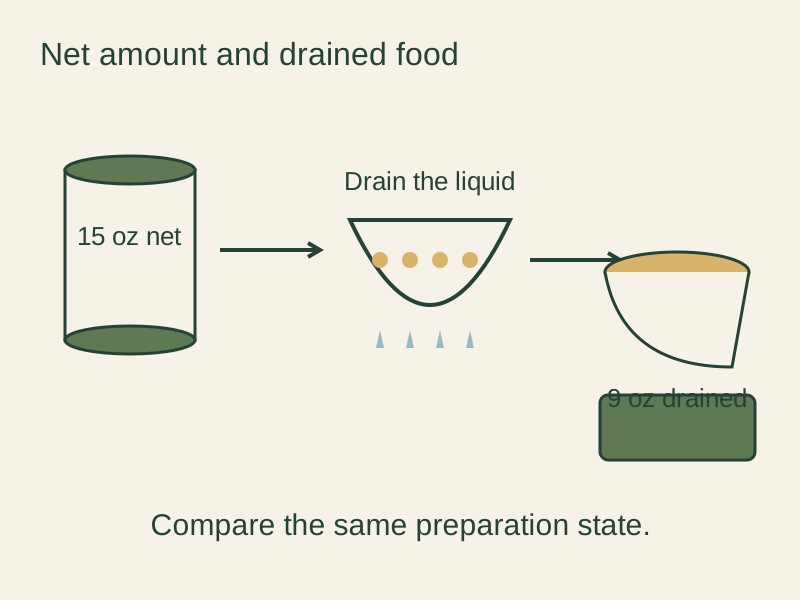
Imagine a teaching example with a 15-ounce can and a separate 9-ounce drained-weight statement. The 15 ounces describes the packed contents, while the 9 ounces answers how much drained food the label says you get.
If your recipe needs 18 ounces of drained beans, two of those example cans match that amount. Dividing 18 by 15 would mix a drained requirement with a packed quantity and leave you short.
Now imagine a second can with 14 ounces net weight and no drained weight shown. You cannot conclude that it supplies more or fewer beans than the first can from those front-panel amounts alone.
The gap between the two quantities is the missing information. Look for the maker's exact product details or use a measured household yield from a previous can of that same variety.
Keep any measured yield labeled as your observation. It is useful for your recipe planning, but it does not establish a regulated drained weight or guarantee the same result from every can.
Put both choices on the same basis
For a drained-food comparison, divide the total delivered price by the total drained amount you will use. If you compare one product per drained ounce and another per net ounce, the neat-looking unit prices still describe different things.
Consider two imaginary packages, both with an explicitly stated drained amount. A $2.40 package yielding 8 drained ounces costs 30 cents per drained ounce, while a $3.00 package yielding 12 costs 25 cents.
Those numbers are arithmetic examples, not current offers. The second has the lower cost per drained ounce, but it only helps if its ingredients, package size, and amount suit your meal.
For a multipack, multiply the per-container drained quantity by the number of containers before dividing. Check whether the price includes delivery or another required charge so your comparison reflects the purchase you would actually make.
Do not substitute the Nutrition Facts serving count for a drained-weight statement without checking the serving description. A serving can describe a different preparation state, and an approximate count is not an exact measurement of the solids in your bowl.
Illustration: swipe left or right, or focus the diagram and use the arrow keys, to see every label.
When the label does not give a drained weight
You still have several practical options, but none involves inventing a percentage. Start with the exact product's current label or manufacturer page rather than a general yield chart for a different bean.
If the maker publishes preparation yield, check whether it describes drained beans, rinsed beans, or beans with liquid. Use the figure only for the preparation your recipe requires.
For a product you already buy, you can record a kitchen estimate after preparing it normally. Set an empty bowl on your scale, tare it, and weigh the drained food without counting the bowl.
Follow the same draining routine each time if you want the notes to be comparable. A few drops clinging to the beans and a long draining period can change a small household measurement.
You do not need laboratory precision to decide whether dinner needs another can. Write “about enough for one salad” or your measured amount, and leave some flexibility when a recipe can tolerate it.
For an exact recipe with little flexibility, choose a package with clear quantity information or buy enough to cover an uncertain yield. Make a plan for any extra food using its after-opening directions instead of assuming it can stay in the pantry.
Match the comparison to the food
Chickpeas, olives, mushrooms, and fruit do not all use their packing liquid in the same way. Decide what the recipe needs before treating drained yield as the most important number.
A tomato recipe might deliberately include the juices. Comparing only the weight of drained tomatoes could make you pay for a texture or format the recipe never wanted.
Fruit packed in juice and fruit packed in syrup also bring different ingredients into the comparison. Matching the edible amount does not make those products identical for flavor or a particular recipe.
If you plan to use chickpea liquid in another dish, you can note that separate use. Avoid counting the same liquid as a savings twice, once as part of the beans and again as a substitute you would not otherwise buy.
For a seasoned bean product, ask whether the sauce is useful or something you will remove. The answer changes whether a larger net amount helps your meal or simply creates more waste.
Check the recipe's own wording
“Two cans of chickpeas” is less precise than a stated drained quantity. Look for the can size, whether the recipe says drained or undrained, and any notes about substitutions.
If you are adapting a familiar recipe, change one quantity assumption at a time. Switching the brand, can size, and draining method together makes it harder to understand why the meal turned out differently.
For a flexible soup, you can often make a sensible editorial adjustment to the amount of beans you prefer. For a carefully developed recipe, use the author's stated quantity or ask for clarification before making a large batch.
A useful shopping note might read “drained chickpeas for two lunches” followed by the amount your recipe specifies. That connects the package calculation with a real use rather than an abstract goal to buy the biggest can.
Leave the aisle with a usable answer
You should be able to identify the product, its net amount, whether a drained amount is stated, and the quantity your recipe needs. If a crucial number is missing, treat it as missing rather than filling it with a guess from a different food.
Once you understand that distinction, the front of the can becomes easier to read. Choose the package that supplies the right food in a practical amount, then compare price on that same basis.
Sources & product information
Relevant pages checked October 28–29, 2026. Product information is the maker’s or retailer’s description; the practical examples and choices are Shelf Savvy editorial guidance.