How to Scale Oatmeal Using the Package Directions
When you make oatmeal for more people, begin with the package's directions for that batch size. Do not assume every field in the single-serving method should be multiplied by the same number.
In this guide
- Read the row for the batch you want
- Define the amount you actually want to make
- Keep the product and cooking method fixed
- Copy the complete larger-batch row
- Scale an actual recipe rather than a remembered ratio
- Choose equipment before heating
- Treat toppings as their own calculation
- Record a useful result
- Make the next batch repeatable
Read the row for the batch you want
When you make oatmeal for more people, begin with the package's directions for that batch size. Do not assume every field in the single-serving method should be multiplied by the same number.
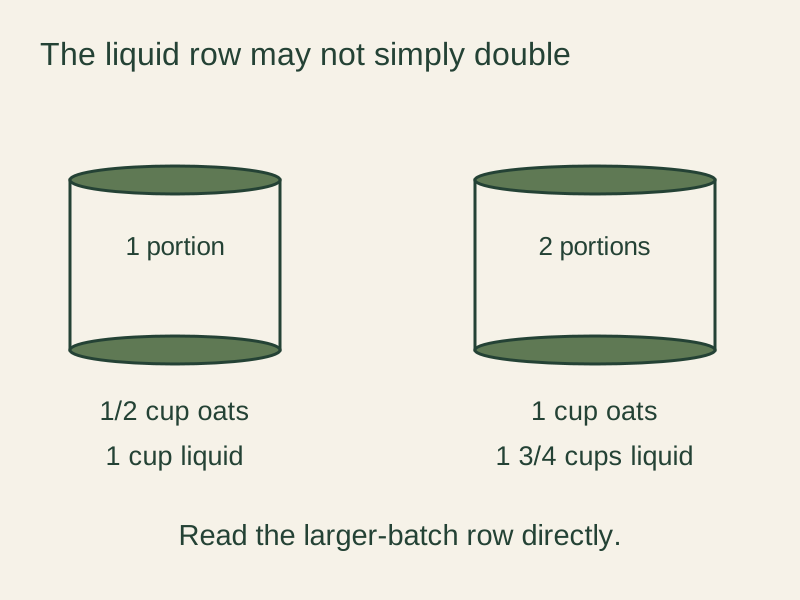
A useful example appears on Quaker's Old Fashioned Oats page. Its stovetop instructions list half a cup of oats with one cup of liquid for one serving, but one cup of oats with one and three-quarter cups of liquid for two.
The oats double while the listed liquid does not. That is why reading the two-serving directions is more dependable than automatically doubling the first row.
Those quantities belong to that exact named product and method. Use your own package's instructions if you have another form, brand, or preparation method.
Define the amount you actually want to make
Count the breakfasts or bowls you need, then decide whether the label's reference serving fits your plan. A child, an adult, and a meal with other foods may not all use identical portions.
You can plan from the recipe quantity without turning the label serving into a rule about how much anyone should eat. Keep the dry oat amount visible so the batch calculation has a clear basis.
If you want leftovers, include them deliberately rather than doubling the batch just because the pot is large. Decide how the prepared oatmeal will be stored using relevant guidance for that food.
If the need is uncertain, a smaller fresh batch may be easier to manage. You can learn the household's usual amount before buying or cooking much more.
For a recipe with toppings, remember that the oat base and the complete breakfast are different quantities. Plan fruit, milk, nuts, or other additions separately from the dry oats.

Keep the product and cooking method fixed
Read whether you have old-fashioned rolled, quick, instant, or steel-cut oats. A water amount and timing copied from one form should not be treated as a universal oat method.
Then choose stovetop, microwave, or another supported preparation. Find the directions for that method before changing the batch size.
A stovetop two-serving row and a microwave one-serving row are not two halves of one recipe. Keep the equipment, liquid, sequence, and time together.
If your package offers only a small microwave batch, do not assume a much larger bowl with multiplied timing is supported. Use a published larger-batch method or a different appropriate cooking method.
Check the appliance and container instructions too. The ability to fit a mixture into a bowl does not establish that it will cook properly or remain contained during heating.
Copy the complete larger-batch row
Write the oat amount, liquid amount, optional ingredients, heat level, and stated method on one line or card. That reduces the chance of reading the oats from one row and the water from another.
For the Quaker example, the two-serving stovetop row gives one cup of oats and one and three-quarter cups of water or milk. Keep that combination with its own preparation instructions rather than attaching another product's cook time.
If you use a different liquid, check that the product or recipe supports it. Do not assume a substitution behaves identically simply because it measures the same volume.
When directions call for a measured cup, use a suitable measuring tool. A mug you call a cup can introduce a different amount each time and make the batch seem unpredictable.
If a recipe provides weights and you prefer that method, use the actual stated weights. Avoid converting between weight and volume with a generic food density that may not match your oats.
Illustration: swipe left or right, or focus the diagram and use the arrow keys, to see every label.
Scale an actual recipe rather than a remembered ratio
For a recipe beyond the package's listed batch sizes, look for a supported version that makes the amount you need. A manufacturer recipe or a clearly developed method gives you more than a bare multiplication rule.
If you deliberately adapt a flexible stovetop recipe, record your starting amounts and observations. Label the change as your household adjustment, not as the maker's official direction.
Do not assume a larger batch takes exactly the same time or exactly twice as long. Follow the method's cues and relevant equipment guidance instead of using arithmetic as a substitute for cooking instructions.
Make one manageable change at a time. If you change oat form, liquid, pot, and quantity together, you will have several possible explanations for the result.
For a shared kitchen, leave the current recipe card beside the ingredients. That is easier to follow than a message saying “make twice as much as usual.”
Choose equipment before heating
Use the pot or bowl appropriate to the published method and amount. Leave the space required for stirring and the behavior of the mixture during cooking.
Keep the package's microwave instructions separate from a stovetop method. The original Quaker page, for example, describes its one-serving microwave preparation with a medium microwave-safe bowl and a particular time range.
Do not infer a universal safe bowl size from that example. The product, appliance, and batch need their own compatible guidance.
Have your measuring tools and any additions ready before you begin. Stopping to find a container after the mixture is heating makes it easier to lose track of what you already added.
If you are preparing several breakfasts in sequence, mark which batch is in the pot. Repeating a familiar recipe can still lead to a duplicated addition when you are interrupted.
Treat toppings as their own calculation
List the amount of each topping you intend to use across the whole batch. That makes the grocery list clearer than assuming every ingredient should double just because the oats did.
For a household with different preferences, you can prepare an appropriate plain base and add toppings individually. Follow suitable handling directions for each addition rather than leaving perishable ingredients out while everyone eats at a different time.
If you are following a nutrition plan, include the additions on the same consistent portion basis. A dry-oat serving does not automatically include what you pour over the cooked bowl.
For a recipe with an allergen concern, preserve the exact product identity and relevant label information. A common breakfast pot is not a reason to ignore different household requirements.
Record a useful result
After the meal, note the product, batch size, cooking method, and whether the amount suited the household. A short observation can improve the next shopping and cooking plan.
If the texture was not what you wanted, start by checking whether you used the correct product row and measuring tools. Correcting a row mix-up is more useful than inventing a new oat-to-water rule.
Keep any preference adjustment beside the original directions. You may like a particular texture, but another cook should still be able to see what the package actually said.
If you prepared too much, reduce the next planned amount rather than treating leftovers as a permanent reason to cook more. Your actual schedule should guide the batch size.
Make the next batch repeatable
A good scaling note names the exact oats, the supported method, and the complete ingredient amounts. Keep those details together where you normally make breakfast.
Start from the package's larger-batch row when it exists. That small reading habit can prevent the most avoidable mistake: doubling a number that the maker did not tell you to double.
Sources & product information
Relevant pages checked October 28–29, 2026. Product information is the maker’s or retailer’s description; the practical examples and choices are Shelf Savvy editorial guidance.