How to Keep Track of Yeast Storage Instructions
Yeast storage is easiest to manage when you can identify the exact product and find its instructions without searching. Keep the original package or a complete, clearly matched label record with the food.
In this guide
- Keep the directions attached to the yeast
- Capture the information before the package changes
- Separate unopened and opened directions
- Make the storage place part of the label system
- Keep use instructions and storage instructions separate
- Calculate reminders only from an actual instruction
- Deal with an unknown history plainly
- Build storage into the baking sequence
- Let the package keep its own identity
Keep the directions attached to the yeast
Yeast storage is easiest to manage when you can identify the exact product and find its instructions without searching. Keep the original package or a complete, clearly matched label record with the food.
Do not rely on a general reminder that says only “keep cold.” You need to know whether the package is opened, what type of yeast it is, and what the manufacturer says about that format.
The package distinction can matter even within one brand. Red Star's All-Natural Active Dry packets give a four-week instruction for an opened remainder, while its Quick-Rise Instant jar gives four months after opening under its stated storage conditions.
Those are specific product examples, not interchangeable rules. Read the exact container in your kitchen rather than transferring a deadline from a different yeast.
Capture the information before the package changes
Read the storage section before you cut a strip apart, fold a packet, or move a jar. Make sure the product name and relevant directions remain readable afterward.
Photograph the front, ingredients, storage instructions, printed date wording, and any identifying codes if you need a backup. Check the images while the original package is still available.
A small packet can carry information on an edge or flap that is easy to cut away. Keep that portion outside the food container or save a complete photograph before discarding it.
For a jar, do not cover the original code with a large opening label. Place your note where it helps without hiding the manufacturer's own information.
Give any transferred container a short identifier that connects it to the complete record. “Yeast Y2” is useful only if Y2 actually leads to the exact package information.


Separate unopened and opened directions
Read both sections rather than assuming the unopened instructions continue after you break the seal. Opening can change the handling directions even though the product name stays the same.
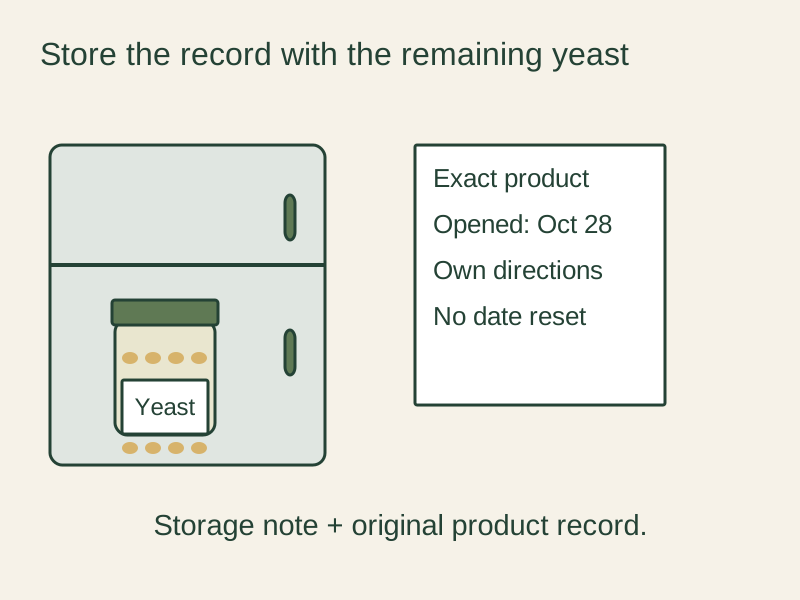
Mark the first opening date when the manufacturer asks for it or when it helps you follow the instruction. Do not reset that date when you move the package or use another spoonful.
A transfer date can be recorded separately if it is useful. It should not quietly replace the earlier opening event.
For a strip of packets, keep each unopened unit identifiable. Opening one packet does not mean you should mark all the separately sealed units as opened on that date.
For a partially used packet, follow the exact closure and storage instructions given for its remainder. Do not treat it as an unopened packet merely because you clipped the top shut.
Make the storage place part of the label system
Choose the actual storage location from the product's directions. A note that says “refrigerate” is useful only when the yeast returns to the correct place after use.
Keep a small, clearly identified area for the yeast so you do not mistake it for another baking ingredient. If you store more than one type, make the names readable without opening either container.
Check that the package can close as intended and remains protected during normal use. Do not put a damaged packet into an anonymous container and assume the problem is solved.
The Quick-Rise Instant jar page above tells users to take out only the amount needed and promptly reseal and return the rest to storage. Use that named guidance when it matches your product, rather than leaving the whole jar out through a baking session.
If another product gives a different method, keep its own instructions with it. The useful habit is following the right information, not forcing every yeast into the same routine.
Illustration: swipe left or right, or focus the diagram and use the arrow keys, to see every label.
Keep use instructions and storage instructions separate
A liquid temperature for mixing yeast is not a storage temperature. Mark the headings clearly if you copy a quick note from a crowded package.
Likewise, a recommendation to bring a measured amount to a particular condition before use is not permission to leave the remaining supply there. Read the complete sequence.
Keep any rehydration method or activity-test directions in a separate part of your recipe notes. It is easy to confuse those steps when all the information is copied under one vague “yeast” heading.
If a recipe names a different yeast, compare both the usage and storage requirements before substituting. A product change affects what you do with the leftover supply as well as what you add to today's dough.
For a bread machine, retain the machine-specific recipe and course information separately. That helps you avoid carrying a hand-baking method into a fixed program without checking it.
Calculate reminders only from an actual instruction
If the package supplies an after-opening period, use the real opening date and that exact period to set a reminder. Keep the original wording available so the reminder has a clear basis.
Label it as a reminder rather than rewriting it as a manufacturer-printed date. A personal calendar note should not look like a new guarantee about quality or performance.
Do not assign a period when the relevant instructions are missing. Find the exact product guidance or ask the manufacturer rather than borrowing an appealing number from another package.
A reminder also depends on the stated storage conditions. If the history is uncertain or the food was not kept as directed, a calendar calculation cannot repair that gap.
When you replace the yeast, replace the reminder and label record too. Leaving the old opening note on a new jar is an easy way to make the system less trustworthy.
Deal with an unknown history plainly
Write “opening date unknown” if you do not know when the package was first opened. Check the product's directions and ask the manufacturer for the specific question you cannot resolve.
A purchase receipt tells you when you bought it, not necessarily when you opened it. Do not turn a receipt date into a more reassuring opening date without evidence.
If your concern is whether the yeast remains active, use the maker's actual activity-test method where appropriate. A homemade shortcut with different amounts and conditions may not answer the same question.
Even a satisfactory activity test does not change the product's identity or handling history. Keep the test result as an observation for that method rather than a new shelf-life label.
For an important bake, replacing an uncertain supply with an appropriate clearly identified product may be simpler. Choose a manageable amount so the same uncertainty does not repeat.
Build storage into the baking sequence
Before starting, read the recipe and take out the amount of yeast it requests using a clean, dry measuring tool. Close and return the remaining supply according to its directions.
After baking, check that the package is back in its assigned place. A small end-of-session check can be more useful than an elaborate tracking spreadsheet.
If someone else in the household bakes, show them the opening note and full instructions. The system should work without needing the person who bought the yeast to remember every detail.
Keep a separate count of unopened backup units if you buy several. That prevents a low-looking active container from triggering another unnecessary multipack order.
Let the package keep its own identity
A useful yeast-storage record answers what the product is, whether it is open, when that happened, and which exact directions apply. It does not rely on a universal rule copied from another format.
Keep that record small, readable, and physically connected to the food. Then storage becomes a repeatable part of baking instead of a question you have to solve again every time you open the refrigerator.
Sources & product information
Relevant pages checked October 28–29, 2026. Product information is the maker’s or retailer’s description; the practical examples and choices are Shelf Savvy editorial guidance.